


Red, Green, Amber: The Traffic-Light Logic Behind Every Safe Gate


Most gate accidents don't happen because a gate malfunctions. They happen because a driver, cyclist, or pedestrian couldn't tell what the gate was about to do. A closed gate blends into a dark tree line. A moving barrier arm is nearly invisible against headlights. A swing gate mid-arc gives no warning before it meets a bumper. The gate did its job it just didn't communicate.
That communication gap is the real safety problem in access control, and it's the same problem whether the gate is a barrier arm at a parking garage, a swing gate at a gated community, a slide gate at an industrial yard, or a folding arm tucked under a low-clearance structure. The fix isn't a stronger motor or a heavier arm. It's light.
Why Visibility, Not Strength, Prevents Most Collisions
Reflective tape and bright paint were the industry's answer for decades, and they still have a place. But tape fades, paint chips, and both depend entirely on an external light source headlights, streetlamps, daylight hitting the gate at the right angle. At night, in fog, in rain, or simply when a driver is looking at their phone instead of the road, passive visibility isn't enough. A closed gate that looks the same in the dark as an open lane is a collision waiting to happen, and low-lit environments like parking structures and after-hours industrial sites are exactly where GateArms+ sees this pattern repeat.
Active lighting solves the problem differently: instead of relying on a driver to notice the gate, the gate tells the driver what it's doing. That's the logic behind color-coded LED gate lighting, and it borrows the one visual language every driver already understands the traffic light.
The Color System, Explained
Across the GateArms+ product line: LED Barrier Arms, LED Swing Gate Kits, LED Slide Gate Kits, and the LED FoldArm90 and FoldArm180 the same programmable logic applies:
Solid red means the gate is fully closed.
Flashing red means the gate is in motion the highest-risk moment.
Solid green means the gate is fully open and the path is clear.
Flashing amber is reserved for interlock situations or, on some swing gate configurations, as an advance warning before a timed closure begins.
That last detail matters more than it sounds. A gate that flashes amber before it closes gives a driver or pedestrian a few extra seconds of warning the same margin a yellow traffic light provides before a red. It's a small design choice with an outsized effect on preventing "the gate started closing on me" incidents, which are among the most common complaints at self-storage facilities, apartment communities, and gated commercial lots.
All of this is driven by a single programmable LED Controller that reads the open, close, and auxiliary signals directly from the gate operator — DoorKing, LiftMaster, HySecurity, All-O-Matic, and other common brands so the lighting stays in sync with the gate's actual position rather than running on a separate timer that can drift out of step.
Matching the Light System to the Gate
Not every property has the same gate, which is why lighting can't be one-size-fits-all:
Barrier arms, the swing-up arms common at parking garages, gated lots, and controlled vehicle lanes, use a 3-inch round aluminum pole with LEDs built directly into the arm rather than a strip taped on afterward, available from 8 to 17 feet with single- or double-sided lighting and breakaway mounting nuts.
Swing gates and slide gates, more common at residential communities, industrial yards, and perimeter fencing, use a retrofit LED retainer track system that clips onto the existing gate frame in horizontal or vertical runs from 5 to 25 feet, so properties don't need to replace a working gate just to add visibility.
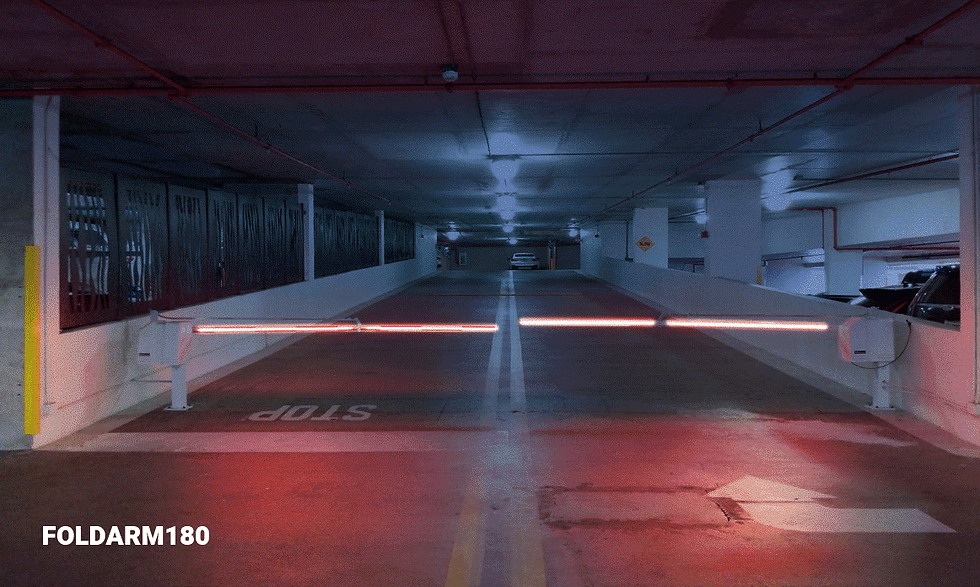
Folding arms, the FoldArm90 and FoldArm180, solve a different problem entirely: low-clearance areas like covered parking structures and parking garages under 8 feet, where a standard rising arm simply won't fit. These fold to the side instead of up, with the same built-in LED signaling and entrapment protection as the standard barrier arm.
In every case, the LED strips carry an IP68 water and dust rating, meaning they're built to run outdoors year-round without the light output degrading the way painted or taped surfaces do.
What This Means for Property Managers and Facility Owners
If your site has a gate that people drive, bike, or walk past after dark, the question isn't really whether to add lighting it's whether the current setup tells people what the gate is doing before they're already at it. A red-yellow-green system removes the guesswork.
Drivers don't have to interpret a barrier arm's position in poor light; they read a color, the same way they read every traffic signal they've seen since they got a license.
For property managers, this also reduces liability exposure. Documented, consistent visual signaling is a straightforward way to show that a reasonable safety standard was in place, particularly at facilities with regular delivery traffic, valet operations, or after-hours access where a gate might be interacted with in low light without an attendant present.
Every gate on a property the barrier arm at the entrance, the swing gate at the back lot, the slide gate along the fence line, the folding arm under the parking structure is a moment where a vehicle or person and a moving piece of equipment share the same space.
Lighting that logic clearly is one of the simplest upgrades a facility can make, and it works with the gate operator already installed.
GateArms+ designs universal LED safety lighting for barrier arms, swing gates, slide gates, and folding arms, compatible with all major gate operator brands. All products are made in the USA and backed by a 1-year limited warranty.